
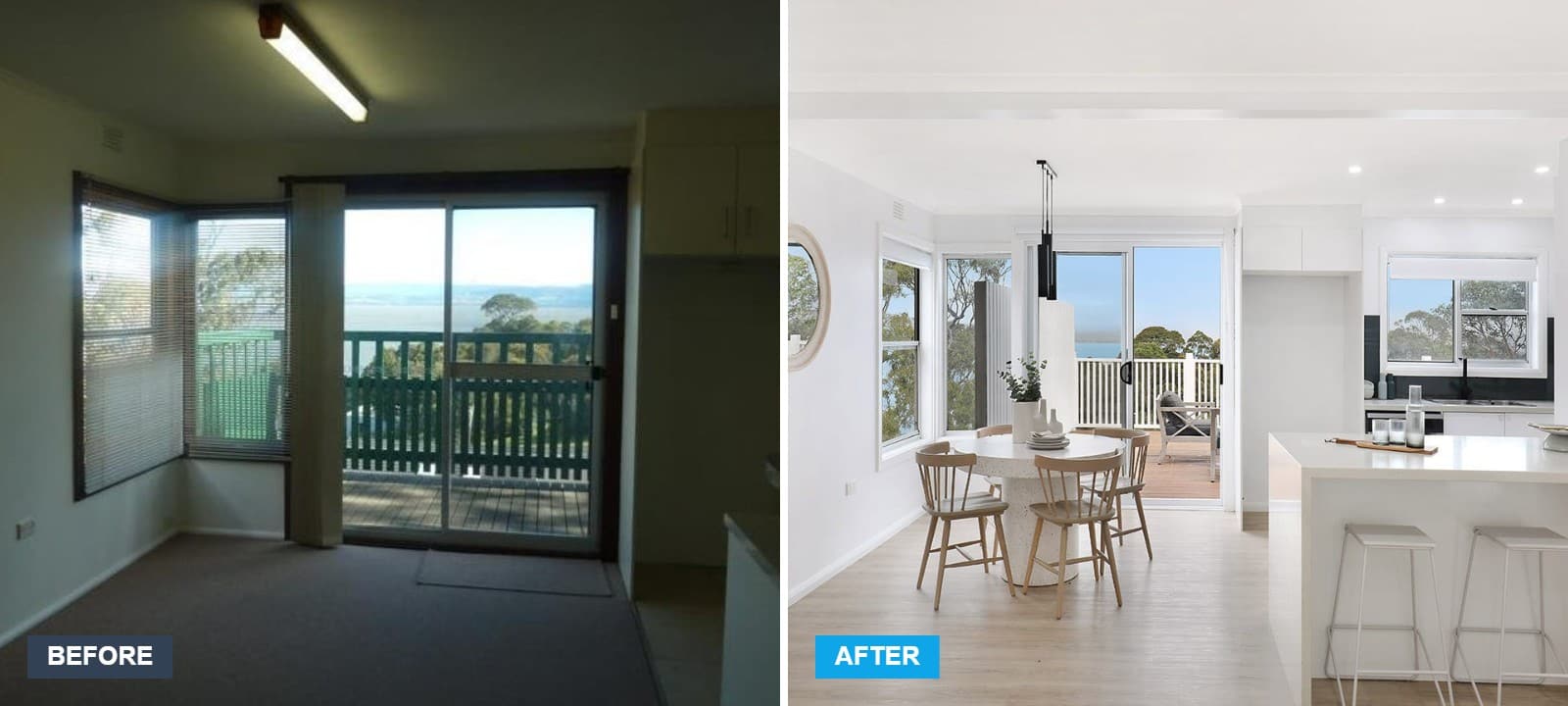
There is a sentence we hear most weeks: "We're thinking of renovating before we sell."
Almost always, what the owner actually wants is not a renovation. It is a better result at settlement. Those are different projects, and confusing them is expensive.
Renovating is for living. Optimising is for selling
A renovation is built around taste and lifestyle. You choose what you want, over a timeline that suits you, to a standard you will enjoy for years. The return on that spend is measured in how much you like your home.
Optimising is built around a number. Every decision is tested against one question: does this dollar come back — with margin — at the contract?
Same trades. Same materials. Completely different decision-making.
Four ways optimising behaves differently
1. It starts with measurement, not inspiration. Before anything is chosen, the gap between your likely as-is price and your property's realistic ceiling is measured against comparable settled sales. That gap sets the entire budget. No gap, no works.
2. It has a hard budget cap. A renovation grows. Optimising has a ceiling-derived cap that does not move, because every dollar past it is a dollar you are gifting to the buyer.
3. It is ranked, not comprehensive. Works are ordered by return per dollar and executed top-down until the cap is reached. The bottom of the list is meant to be left undone. A renovation tries to finish everything; optimising deliberately stops.
4. It is neutral, not personal. Warm neutrals, current-but-not-fashionable finishes, clean light. Optimising removes reasons for a buyer to deduct. Renovating adds reasons for you to stay.
The four levels
Our framework runs Repair, Refresh, Refine and Reveal. Most homes need the first two and part of the third. Very few need the fourth.
Repair removes the objections — the leaking tap, the cracked tile, the sticking door, the failed seal. Cheap, unglamorous, and disproportionately valuable, because each one is a small "what else is wrong here?" in the buyer's mind.
Refresh is paint, light, floors, decluttering, presentation. The highest and most reliable return band.
Refine is targeted upgrades — kitchen fronts and benchtop, a bathroom vanity and tapware, landscaping. Conditional on the ceiling.
Reveal is the full presentation layer — styling, photography, first-inspection choreography. It costs the least and is skipped the most often.
What optimising protects you from
The two classic failures:
Overcapitalising — spending $90,000 on a home whose ceiling is $50,000 above where it started. The work is beautiful. The maths is a loss.
Undercapitalising — going to market as-is with a $70,000 gap and no plan, then watching a buyer close that gap for themselves three months later.
Both failures come from the same root cause: nobody measured before deciding.
The honest caveat
Nobody can guarantee an uplift. Markets move, buyers are unpredictable, and any figure quoted before work starts is indicative.
What can be done is to make the decision defensible: real comparable sales, ranked works, indicative costs, a hard cap, and the discipline to recommend doing nothing when the numbers say so.
That is the difference between renovating to sell and optimising to sell.
One is a project. The other is a decision about your equity.
Curious what your home's Sale Gap is?
We measure it onsite and rank the works with indicative costs. On eligible projects the cost is deferred to settlement under your contract; eligibility and conditions apply.
Discover Your Sale GapRead next
What Not to Do Before Selling Your House, Nine Mistakes
The mistakes builders and agents see repeatedly before a sale, why each one costs money, and what to do instead. Doing less, done well, usually wins.
What Adds Value to a House in Australia, and What Doesn't
The improvements that lift a sale price, ranked by speed, return, cost and buyer psychology, plus the things that quietly devalue a house and what to do instead.
Should You Renovate the Bathroom Before Selling?
A builder's three-question rule for deciding whether your bathroom needs a refresh, a full strip-out, or nothing at all before the house goes to market.
Free tools: estimate your Sale Gap, see what going to market as-is could cost with the Cost of Doing Nothing tool, or read how Uplifta works.
Back to all articles